Easy
Overlook only
A brief look
- Step-freeRamp to the deck
- CostNo entry fee
- Valley parking500 yen per car
Guides
Language
Currency
Look up free datesstarting at $47 · cancel without a feeThings to tick off
Answer in a line
Noboribetsu Jigokudani, the Hell Valley, is free to enter, a crater 450 m across, and the car park beside it costs 500 yen for a passenger car.
Cost, access, evening
To do · 9 points
Check off each step as you finish it; the ticks are saved on this device.
0 / 9 ready
Plan complete. Only the booking is left: your seat on the Noboribetsu coach.
Claim a seatJigokudani is the steaming crater above Noboribetsu Onsen. This page covers what it costs, the walk from the overlook to Oyunuma, what the water temperatures are, and how to see it after dark.
Editorial team, sapporodaytrip.com · Updated November 2, 2026 · Roughly 6 minutes to read
Basics at a glance
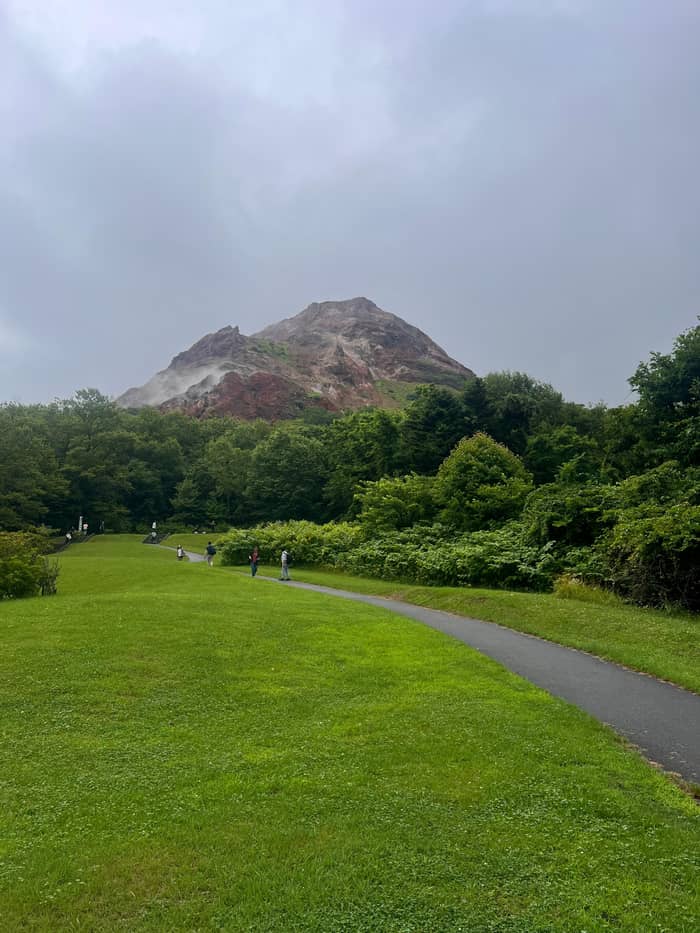
Jigokudani means Hell Valley, and the name fits the view from the deck: a bare, grayish slope streaked with yellow, white steam rising from vents, and the smell of sulfur on the wind. It is the site of a crater 450 m across and 11 hectares in area, created by the volcanic activity of Mount Hiyori.1 The steam you see is the hot-spring supply of the whole resort made visible.
The numbers show how much water is moving. As much as 10,000 tons of hot spring water of various types gush out of the Jigokudani area every day, and it is supplied to the hotels and inns of the resort below.6 Many of the town's baths draw on this one crater, which is why one resort can offer so many kinds of water.
The valley is also young in geological terms. The association says Jigokudani was created by volcanic activity about 10,000 years ago.7 Nothing here is staged. The vents, the bubbling pools and the changing colors of the rock are the process still running, which is why it looks different from one visit to the next.
Trail sheet
| Stop | Found there | Key fact |
|---|---|---|
| Valley parking | Paid parking | 500 yen a car |
| Observation deck | Crater view | Ramp, 8% at most |
| Tessen Pond | Small geyser | Mid-valley |
| Okunoyu | Hot sulfur pond | 75 to 85°C |
| Oyunuma | Gourd-shaped lake | About 1 km around |
| Footbath | Hot river | No fee to enter |
| Sengen Park | Geysers | About every three hours |
Compiled from the Noboribetsu tourism association's pages for each place.2,3,8,5,9,10,14
Entry to the valley is free of charge. If you drive, there is a car park a 1-minute walk from the valley, and it charges 500 yen for a passenger car, with a ticket that is valid only until you leave the lot.2 That means a short stop and a long stop cost the same, so plan the length of your visit before you park.
If you come by bus, you get off at the resort terminal and walk up through the town to the valley path. The Donan bus fare between Noboribetsu Onsen and JR Noboribetsu Station is 350 yen.12 The valley path starts near the Park Service Center at the top of the resort.
Step-free access is better than at most volcanic sites. A wheelchair-accessible ramp with a maximum slope of 8% runs from the Park Service Center to the Jigokudani Observation Deck.3 A stroller can follow the same ramp. The boardwalks beyond the deck are narrower and have steps in places, so ask at the center before committing.
Past the overlook, a wooden path follows the valley floor. Around the middle of the valley is Tessen Pond, a small geyser. It does not spout as much as it used to, but the path lets you look at the river of hot water and stand next to a spring source.8 Even without an eruption, the color of the stream and the steam from the rocks are worth a slow look.
Further up is Okunoyu, a grayish-black sulfur spring that gushes from the bottom of a cone-shaped pond. The surface temperature of the pond is as high as 75°C to 85°C.5 Keep to the boardwalk and the railings. Water that hot scalds.
Photographers should expect fogged glass. Wipe your lens if you walk near the vents, since steam condenses on it, so carry a dry cloth. Color photos work best when the sky is clear, and the steam shows most on a cool morning.
Choose a valley walk
Start from your mobility, the hour and the weather.
If I use a wheelchair or stroller
The overlook ramp
A ramp with a maximum slope of 8% leads to the deck.3
If I arrive in late afternoon
The valley before sunset
The association recommends visiting before sunset.4
If My feet are tired
The free footbath
It is free of charge on the Oyunuma River trail.10
If I come after dinner
Onibi no Michi
Open from sunset to 21:30, free of charge.11
If I have a car and time
The long course
It links Jigokudani, Oyunuma and Lake Kuttara.15
Three ways to do the valley on foot
Easy
A brief look
Full walk
Boardwalk and footbath
A 60-minute loop
Longer course
The trail continues to Oyunuma, a gourd-shaped lake about 1 km around, the remains of a crater formed by the eruption of Mt. Hiyori.9 Sulfur springs of about 130°C spout from the bottom, and even the surface runs about 40°C to 50°C, with a grayish-black color.13
Below the lake, the overflow forms a hot river, and beside it sits a natural footbath. The Oyunuma River natural footbath is free of charge and sits next to Taisho Jigoku on the Oyunuma River scenic trail.10 After a walk on hard boardwalks, a short rest with your feet in warm water is a fair reward. Bring a small towel.
Beyond the footbath, the trail drops back toward the resort through woodland. Sengen Park has geysers that erupt at intervals of about every three hours, so a timed glance at the schedule can turn a casual walk into a show.14 If you have a car and more time, the same road leads on to Lake Kuttara and Mt. Hiyori.
Tour cost
Enter the number of travelers to see each total.
Line up 4 choices
Enter the number of travelers to see each total.
≈
View≈
View≈
View≈
ViewThe lowest GetYourGuide prices appear here after conversion with the ECB reference rate, and the booking page gives the precise total.
Along the trail, in order
Start
The step-free ramp to the overlook starts here, 8% at most.3
Deck view
The crater is 450 m across and 11 hectares.1
Mid-valley
A small geyser, with a wooden path beside the hot stream.8
Upper trail
Surface temperature reaches 75°C to 85°C.5
Lake edge
A lake about 1 km around, with a free natural footbath below.9,10
Once the sun is down
Open from sunset to 21:30 and free of charge.11
The valley does not close at dusk. The lights at the Jigokudani Observatory are on until around 11:00 PM, and the area is not locked off, though the association recommends visiting before sunset if you want to see it.4 Onibi no Michi, the lit path, is free and open all year from sunset to 21:30.11 At that hour the steam picks up the lights and the valley looks like a stage set.
On set nights the valley hosts demon fireworks. Tickets are 500 yen per adult, with elementary school children and younger free.35 The show starts at 8:00 pm and lasts about 15 minutes, and spectators are limited to 1,000.36,37 Check the association's calendar for this year's dates, because they differ by month.
Go with a plan. Carry a small torch or phone light for the unlit stretches, wear shoes with grip, and keep to the path. In the dark you cannot judge where the boardwalk ends, and the ground beside it can be hot. If you go alone, tell someone at your hotel where you are headed.
Video
Miel Citron on YouTube · The video only loads from YouTube after you press play.
The area is not locked off, but if you want to see Jigokudani, it is recommended to visit before sunset
Safety here covers heat, wildlife and weather. On heat: steam and hot water are at the edge of the path, so never leave the boardwalk, never touch the streams, and never let children climb the railings. On wildlife: the City of Noboribetsu posts brown bear sighting notices on its official website, and several appeared between 25 October and 1 November 2026.38
On weather: the area around Jigokudani has been a national natural monument since 1924, with about 60 kinds of trees and 110 kinds of plants in the forest.39 That woodland is cold, wet and slippery in winter, and the wooden paths can ice over. Pack shoes with grip and a layer more than you think you need.
Respect the notices at the visitor center and the signs on the path. Sulfur gas can drift across the walkway, and anyone with breathing problems should be cautious. When in doubt, watch from the overlook and skip the far end of the trail.
The easiest way to include the valley in a trip from Sapporo is a bus day. The Sapporo, Noboribetsu and Lake Toya day tour lists Jigokudani as its first named stop, followed by Cape Chikyu and the Silo Observation Deck, over a 10-hour day with pickup and a guide in English and Japanese, from $47.
Other listings follow a similar pattern. One lists Jigokudani as Hell Valley in a 10-hour day from $45, and another bundles the valley with Lake Toya in a one-day trip from $54. The three differ in length, stops and guide languages, so compare the facts and not the titles.
A tour gives you a fixed window at the valley, so decide in advance how you want to spend it. If you want the full boardwalk to Oyunuma and the footbath, check the stop time shown on the booking page. If you want more time, take the train and bus and spend a half day here on your own.
FAQ
Entry is free of charge, and the nearby car park charges 500 yen for a passenger car.2
It covers 11 hectares and was created by the volcanic activity of Mt. Hiyori.1
A ramp with a maximum slope of 8% runs from the Park Service Center to the Jigokudani Observation Deck.3
Water that hot scalds, so stay on the boardwalk.5
The Oyunuma River natural footbath is free of charge and sits next to Taisho Jigoku.10
The City of Noboribetsu publishes brown bear notices on its website; check before forest walks.38
The day tour lists Jigokudani as one stop in a 10-hour day, and the booking page shows how long each stop lasts, so check it before planning the walk to Oyunuma.
Sources
Keep reading
Planning a day out of Sapporo? A real person answers here.